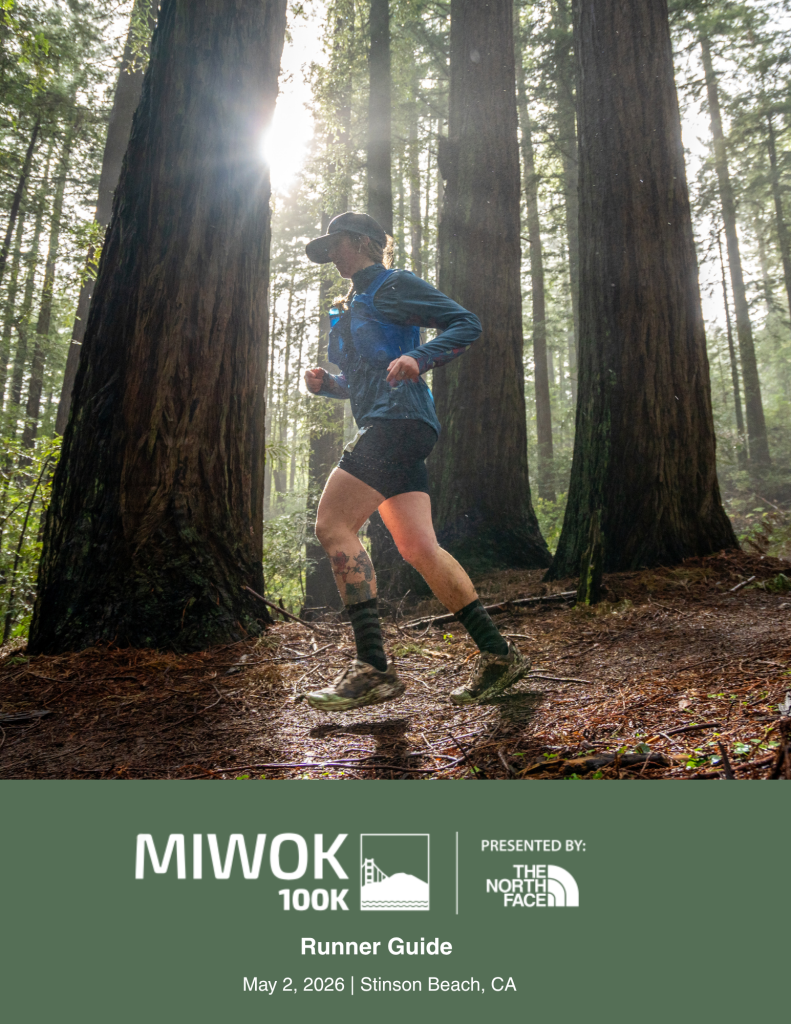
My heart is full, and I am soaking in all the energy I felt from this past weekend. To serve this community is more than a role; it is a profound honor. Today, the only word that remains is gratitude. The 30th edition of the Miwok 100K, presented by The North Face, is in the books, and it was beyond memorable. Course records fell, challenges were conquered, sweat and tears were shed. At the end, something transformative happened, and we all came away a little bit stronger than before.
There is a specific kind of magic woven into these beautiful trails, and you were the heartbeat that brought it to life. Whether you flew across the finish line in personal record time or left a piece of your soul deep within the silent redwoods, your presence was an offering. You honored the land and the community. Running 100 kilometers is a feat of physical endurance, but what makes the Miwok 100K community special is how you run. From the steep climbs to the weeping coastal views, you navigated the trails with grace and grit, proving why this race remains a cornerstone of the trail community. Congratulations to all of you who showed up and gave it your all.
This race does not breathe without the amazing volunteers and partners. Thank you from the bottom of my heart for your gift of time, the strength of your partnership, and your trust.
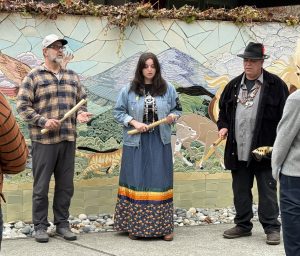
Elissa Simons (center) and her father, John (left), along with other members of the Coast Miwok Tribe, attended the celebration of a recent land acquisition in Marin County.
Every year, runners gather in the Marin Headlands for one of the most challenging and beautiful races in ultrarunning: the Miwok 100K Presented by The North Face.
The course winds through coastal ridgelines, redwood groves, and open hillsides overlooking the Pacific. It is a place that demands humility and respect from everyone who runs it.
Long before it became a race course, these lands were home to the Coast Miwok people.
For thousands of years, Coast Miwok communities lived along the shores and in the valleys of what is now Marin County, developing a deep and enduring relationship with the land and water that continues to this day.
One of the goals of the Miwok 100K has always been to honor the place where the race takes place. This year, that commitment has taken on new meaning through a collaboration with members of the Coast Miwok community. We had the privilege of speaking with the Simons family: Elissa, Kody, and their father, John, all members of the Coast Miwok Tribe, about their work, their culture, and their deep commitment to bringing the story of their people to the forefront.
A Living Culture
For many people, Indigenous history is often framed as something that belongs only to the past. But as Coast Miwok cultural advocate Elissa Simons explains, that narrative misses an important truth.
The Coast Miwok are not simply a chapter in California’s history.
They are a living culture.
“We have been here for thousands of years,” Simons shared. “And we’re still here.”
Simons works with Huukuiko Inc., a nonprofit dedicated to cultural revitalization and community engagement. The organization focuses on strengthening tribal connections through education, storytelling, language revitalization, and land stewardship.
One of their long-term goals is to develop a cultural center on recently acquired land in Marin County where community members can gather for ceremonies, language programs, and cultural events.
Sharing that culture with the broader community is also a central part of their work.
“We want people to understand that this is a living culture,” Simons explained. “We may have been displaced, but we are still here, and we are reclaiming and rebuilding things that were lost.”
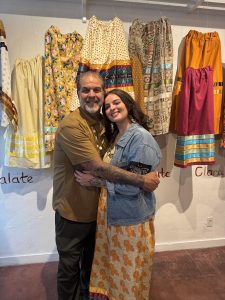
John and Elissa pause for a photo at a ribbon skirt exhibition where Elissa was a contributing artist.
A Collaboration Rooted in Respect
The connection between the Miwok 100K and the Coast Miwok community began simply. Coast Miwok descendant Kody Simons reached out after signing up for the race. Simons had long aspired to run the Miwok 100K, and he wanted to contribute something meaningful to the event that bears his Tribe’s name.
That conversation led to the creation of traditional-inspired bracelets that will be given to runners. The bracelets feature abalone and gray pine nuts, materials that reflect historic trade networks among California Tribes and carry cultural significance.
The collaboration has continued to grow from there. Along with Elissa and John, another Simons family relative, Amber Witzke, is working with race director Magda Boulet on designs for wooden awards that connect the race to indigenous culture and tradition.
For the family, the goal of the partnership is simple.
It’s about honoring the ancestors and elders who cared for this land for generations.
Running with Purpose
This year’s race will carry special meaning for Kody Simons, who will be standing on the start line himself. Simons works as a firefighter-paramedic and runs Liwako Rescue, a company that teaches swiftwater rescue and wilderness safety.
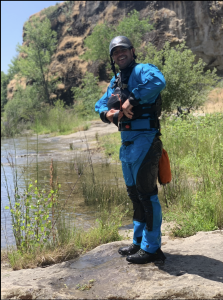
Kody, seen here leading a swift water rescue class.
The name Liwako comes from the Miwok language and translates roughly to “people of the water.” For Simons, running the Miwok 100K is not just an athletic challenge. It is also a deeply personal journey.
After going through a difficult period in his life, he described the race as a new chapter.
“I’ve always wanted to run it,” he said. “This felt like the right moment to take on that challenge.”
It will also be his first organized race.
Making this event is particularly important for Kody, as he said, “ I feel that the way my life is now is a direct result of running. As I mentioned, I lost the part of me that was an athlete for a number of years, and running brought me back. I find it to be a very unique and exciting way to take who I am now, look back at who I was, and where my family and I came from, and tie all of those pieces of me together.”
Movement as Connection
During our conversation, the Simons family shared a perspective that resonates deeply with ultrarunning.
In many Indigenous traditions, movement is connected to prayer, ceremony, and a relationship with the land. Dancing around a fire, walking through a landscape, or traveling long distances are all ways of expressing connection and respect.
Running can carry a similar meaning.
“When we move through the land,” Elissa Simons explained, “it can be a way of putting down prayers.”
For runners tackling the steep climbs and rugged trails of the Miwok 100K course, that idea feels especially fitting. The race is demanding, humbling, and deeply tied to the place where it happens.
Looking Ahead
The collaboration between the Miwok 100K and the Coast Miwok community is still evolving. In addition to the bracelets and awards, the race hopes to continue finding ways to highlight the history, culture, and ongoing work of the Coast Miwok people. For the Simons family, the partnership offers runners an opportunity to learn something important about the land they will be traveling across.
The Coast Miwok story did not end centuries ago.
It continues today, in the work of organizations like Huukuiko Inc., in efforts to revitalize language and culture, and in community gatherings such as the annual Marin Pow-Wow.
And this year, it will also continue on the Miwok 100 K trails.
As runners make their way across the ridgelines and valleys of the Marin Headlands, they will move through a landscape shaped by thousands of years of Coast Miwok stewardship and, hopefully, find more meaning in running a 100K trail race.
A landscape that still carries those stories today.